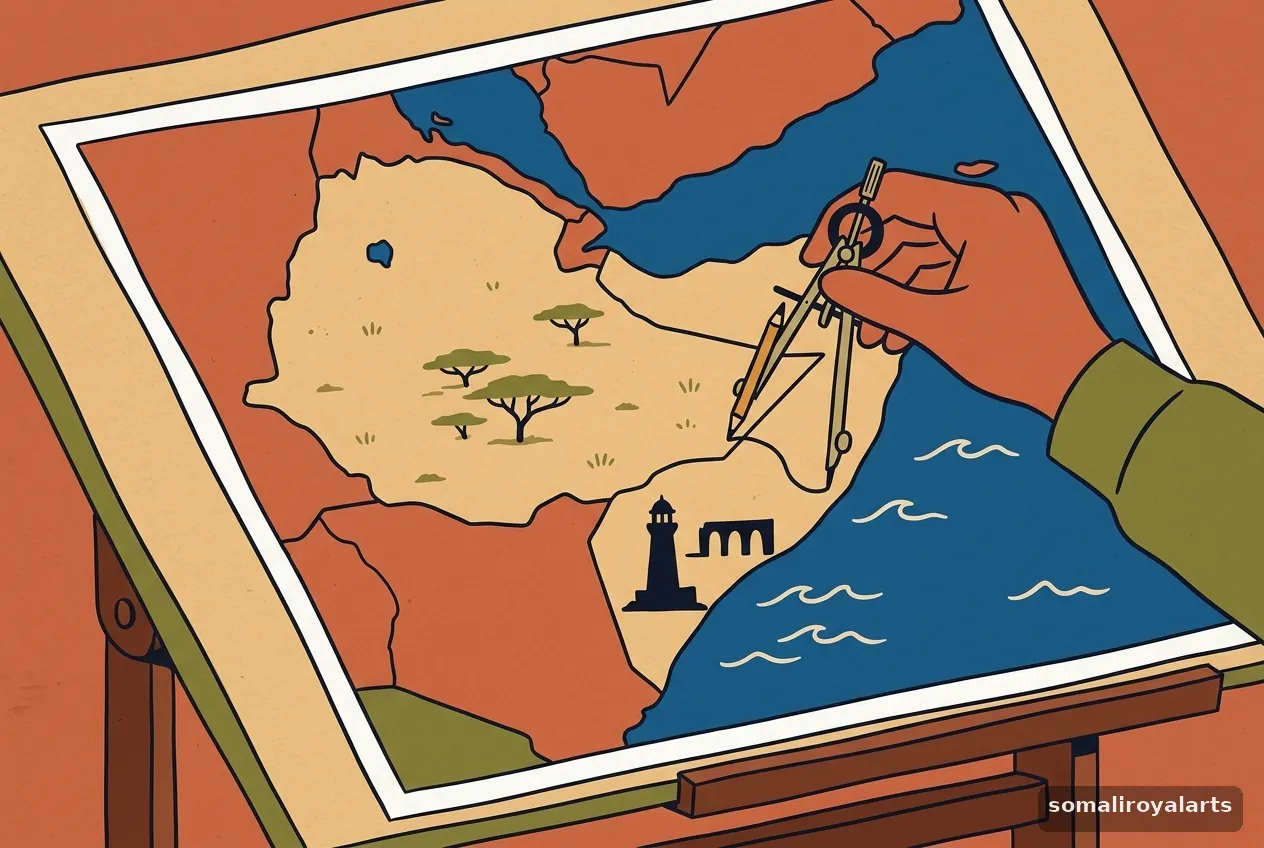
Hassan Sheikh Limits His Somalia to Galkayo and Kismayo
President Hassan Sheikh Mohamud told audiences in Galmudug this week that the federal member states he helped establish stretch from Galkayo to Kismayo, a description that leaves out Puntland, which has run its own administration since 1998, and makes no mention of Somaliland, which walked away in 1991. The president made the remarks at the start of the Galmudug tour, where he framed the federal system as his own accomplishment. The choice of Galkayo as the northern boundary was particularly pointed: it is the city Hassan Sheikh reportedly intends to visit over Puntland's objection, its southern half marks the outer edge of the Somalia he says he built, and his travel plans have already put two administrations on alert. That founding narrative clashes with the recorded history of the federal states. Jubaland emerged in 2013 around Ahmed Madobe's forces, and Hassan Sheikh's first government refused to recognize the outcome until Ethiopian mediation produced the Addis Ababa agreement. Southwest and Galmudug followed through conferences in 2014 and 2015, and Hirshabelle was assembled in 2016 from the two regions no other state would take, over objections from Hiiraan communities that continue to this day. The states came about through bargains among clans, commanders and foreign mediators. Kenya and Ethiopia helped midwife Jubaland over Mogadishu's protests, IGAD chaired the sessions that produced Galmudug's charter, and the men who signed those documents remember who sat across the table. Claiming sole authorship erases the other signatories, and the erasure is the point. A federation built by agreement binds its center; a federation granted by a president can be revoked by one. The constitutional outline the president dismisses as mere paper is the same document that makes the member states parties to the federal compact, and his revision of history turns them from parties into products. The states inside the president's claimed zone have already experienced what being a product means. Southwest's presidency changed hands under Turkish-backed force, Galmudug's election returned a single viable candidate, and Hirshabelle's next leader was settled with Hawadle elders in Mogadishu before the state's own commission had printed a voter roll. Each intervention was justified in the language of national institutions, and each produced a leadership that owes its office to the president's favor. The speech sits awkwardly beside the president's own recent rhetoric. On Tuesday he called for an end to personality-driven politics and clan-based leadership, urging Somalis to wake up, become aware, and build a system that outlasts the men who run it. Within the same week he described the federal map as his personal work. The statements cannot be reconciled with one another. A politics in which member states are one man's accomplishment is personality politics in its purest form. Puntland's response has been sharp. Its administration's statements no longer call Hassan Sheikh the sitting president, its forces treat his movements as a security file, and it tells neighboring states that a federation cannot be safe in the hands of a man who believes he made it. The Galmudug speech will be quoted in Garowe for years, because it says plainly, in the president's own voice, what Puntland has been arguing at length. The speech also lands as international partners backing the state-building project ask why the counter-insurgency is losing ground while the presidency wins elections. Their December funding deadline gives that question teeth. The dispute is not academic. The question of who controls the federal states affects security operations, election legitimacy, and the distribution of international aid and revenue. Puntland's withdrawal of recognition and Jubaland's resistance to federal deployments signal that the center's authority is narrowing, and Hassan Sheikh's own words may accelerate that trend.
Read our sourcing and corrections policy


Be the first to comment on this story!