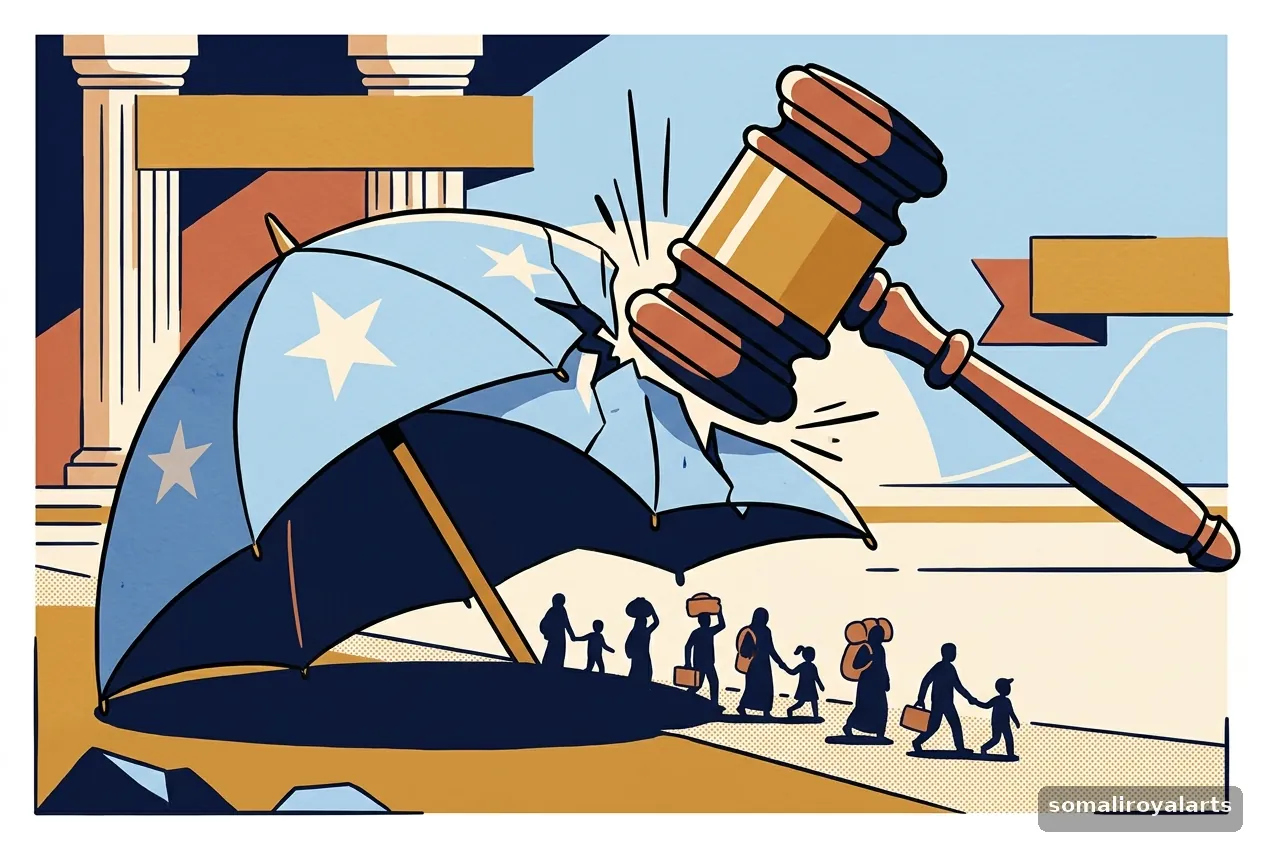
US judge clears Trump administration to end Somali TPS protections
A United States federal judge has cleared the way for President Donald Trump’s administration to terminate Temporary Protected Status (TPS) for Somali nationals. The decision removes a legal barrier that had allowed nearly 1,100 Somalis to continue living and working legally in the United States. The ruling does not mean every affected Somali will immediately face deportation. But people who rely solely on TPS to remain legally in the United States could lose protection from removal and their authorisation to work. Judge Burroughs said the Somali plaintiffs had made a compelling case about the irreparable harm they faced if an injunction were withheld. She also said the balance of hardships and the public interest favoured the plaintiffs because the government had not shown that keeping TPS in place while the case continued would impose an undue burden. However, Burroughs concluded that the plaintiffs had not shown a likelihood of success on the merits of their case, the legal threshold required for an injunction. She said a June 25 Supreme Court ruling in Mullin v. Doe, involving migrants from Haiti and Syria, sharply limited the judiciary’s ability to review Department of Homeland Security decisions ending TPS designations. Burroughs had temporarily blocked the Somalia termination in March after four Somalis and two advocacy groups, African Communities Together and the Partnership for the Advancement of New Americans, sued the administration. They argued that the decision was procedurally flawed and driven by discrimination against non-white immigrants rather than an objective assessment of conditions in Somalia. The case also cited Trump’s immigration rhetoric about the Somali community in Minnesota, where his administration deployed immigration enforcement teams following high-profile fraud investigations. Burroughs said the plaintiffs had presented a strong case that some statements cited in the lawsuit were racist, and that circumstantial evidence clearly showed Somalia and its people were being targeted. But she said Mullin meant this was insufficient to sustain a race-based equal-protection claim. The United States first designated Somalia for TPS in September 1991, as the country descended into civil war after the collapse of its central government. Republican and Democratic administrations extended the protection for more than three decades amid armed conflict, political instability and humanitarian crises. The Biden administration extended and redesignated Somalia for TPS in 2024, citing continuing armed conflict and conditions preventing Somali nationals from returning safely. That designation was due to run until March 17, 2026. In January, then-Homeland Security Secretary Kristi Noem announced that the administration would end it, saying conditions in Somalia had improved enough that the country no longer met the legal requirements for TPS. The official termination notice said 1,082 people held approved Somali TPS status and another 1,383 applications were pending as of December 2025. The administration reached its decision despite continuing fighting between Somali government forces and Al-Shabaab, the Al-Qaeda-linked militant group that controls or contests territory in parts of the country. For Somali families in Minnesota and elsewhere in the United States, the ruling brings immediate uncertainty over work and residence. Those who depend on TPS may now need other legal routes to remain and work in the country.
Read our sourcing and corrections policy

Be the first to comment on this story!