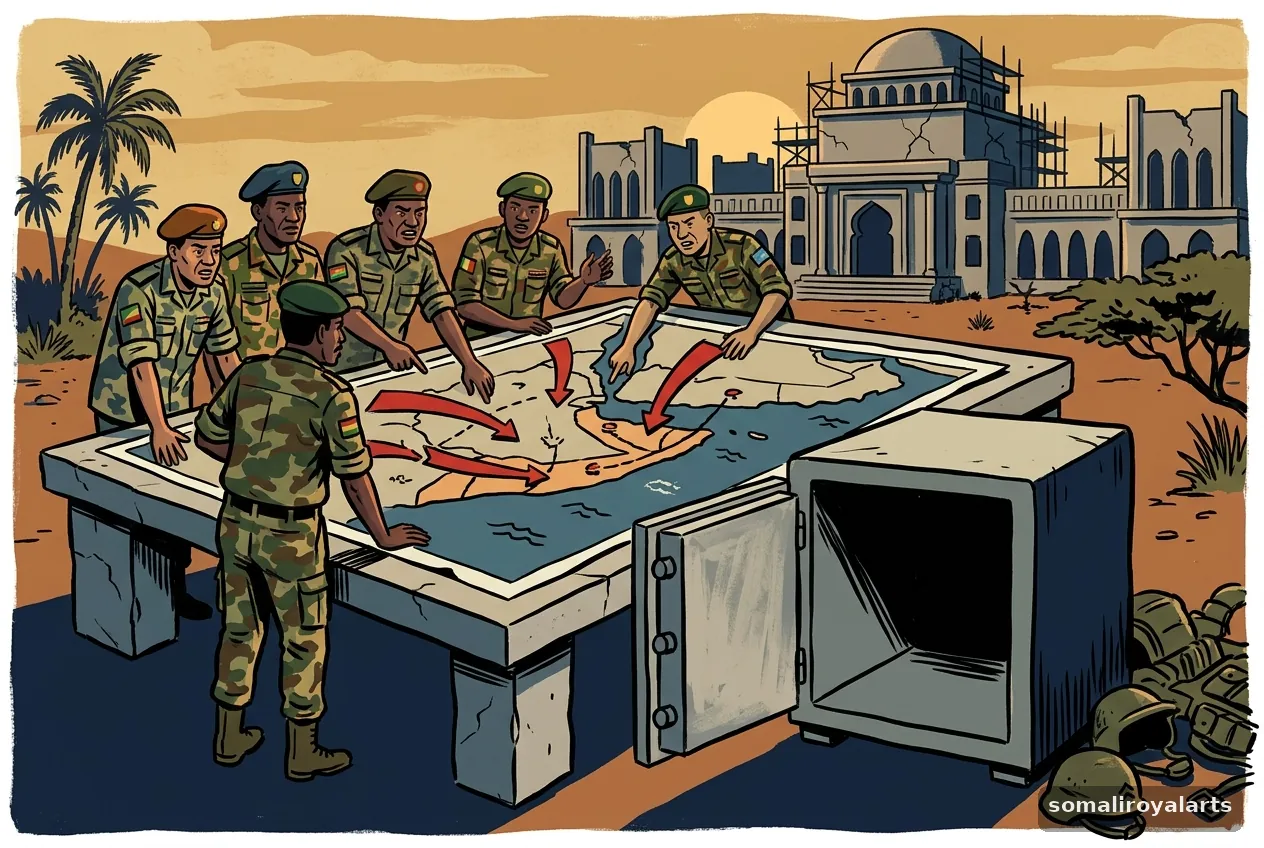
AUSSOM Chiefs Approve Offensive Plan Amid Funding Crisis
Military commanders from countries contributing troops to the African Union Support and Stabilisation Mission in Somalia, AUSSOM, have approved a new offensive framework against al-Shabaab. However, the plan assumes logistical and financial support that external partners, most notably the United States, have moved to withdraw. The mission is therefore preparing a resource-intensive campaign while its underlying funding remains uncertain. The planning sequence began on August 3, when military experts gathered at the AUSSOM force headquarters in Mogadishu. Chaired by Major General Mohamed Ali Bariise, the committee worked to turn political undertakings made at the Kampala extraordinary summit on July 31 into an actionable operational framework. Their proposals moved this week to the defence chiefs, drawing senior commanders to the Somali capital. Among them was Lieutenant General Sam Okiding, deputy commander of the Uganda People’s Defence Forces, who held talks at Villa Somalia. The Somali president thanked Uganda for two decades of deployments. Uganda contributes 4,500 troops to the mission. The framework is a statement of intent rather than a concrete schedule. It calls for accelerated military operations, stronger intelligence sharing between contributing armies, and better coordination of capabilities and resources. Yet an accelerated offensive requires an extensive logistical backbone, including aviation, a steady fuel supply, casualty evacuation and reimbursement systems. AUSSOM does not control those capabilities; they are managed by the United Nations Support Office in Somalia, UNSOS. The financial figures underpinning the mission are stark. For the 2025/26 financial year, AUSSOM required approximately $190 million for troop reimbursements alone, but confirmed pledges reached only $120 million. The African Union’s Peace Support Operations Division said the only assured money was a $502 million UNSOS logistics package. However, Washington’s 25 percent share was withdrawn in October 2025 to cover earlier shortfalls. The UN General Assembly approved a reduced $481 million UNSOS budget for the current year, about 7.5 percent below the previous year, and it is not yet fully financed. Two decades of external financing have supported African Union operations in Somalia. The European Union has contributed roughly 2.8 billion euros, while the United States provided about $1.6 billion directly to troop-contributing countries and another $2 billion through UNSOS. On July 1, Washington informed the African Union that it would not support renewing the AUSSOM mandate when it goes before the UN Security Council in December. The United States has also signalled opposition to financing UNSOS beyond its current authorisation. The Peace Support Operations Division has warned that losing the UNSOS package would leave strategic towns and supply corridors more exposed, weaken medical evacuation and create operational gaps for al-Shabaab. Within the African Union, discussion has shifted from extending the mission towards managing its closure. At a July 3 emergency meeting of military advisers to the Peace and Security Council, Cameroon and Gabon said peace-support operations must eventually end and urged Somalia to build security institutions capable of operating without foreign troops. Uganda has also begun stating publicly that its presence cannot continue indefinitely. Every version of the security transition assumes the Somali National Army will absorb the territory AUSSOM vacates. Recent battlefield developments point in the opposite direction. Over the past year, al-Shabaab has reversed two years of army gains across the central regions. At the start of this month, the group returned to Teedaan in the Hiran region and has retaken other towns that had previously been cleared twice. Analysts tracking the conflict warn that AUSSOM could face operational collapse entering 2027, with Somali forces overstretched and lacking the logistics needed for complex operations. The federal government has meanwhile been deploying military resources elsewhere. Federal-aligned units have been registered and deployed in Mudug, where two of their camps fell to Puntland forces this week. Soldiers captured in Galkayo had been equipped by Mogadishu for a conflict unrelated to al-Shabaab. Puntland has largely funded its own campaign against both al-Shabaab and the Islamic State faction in the Calmiskaad mountains without the UNSOS logistics package, but is now using part of that capacity to police federal deployments on its territory. Without a replacement for UNSOS support, the capacity to secure strategic towns and supply corridors could diminish. The combination of overstretched Somali forces and AUSSOM’s financial uncertainty may create openings for al-Shabaab to retake territory from which it had previously been driven.
Read our sourcing and corrections policy

Be the first to comment on this story!