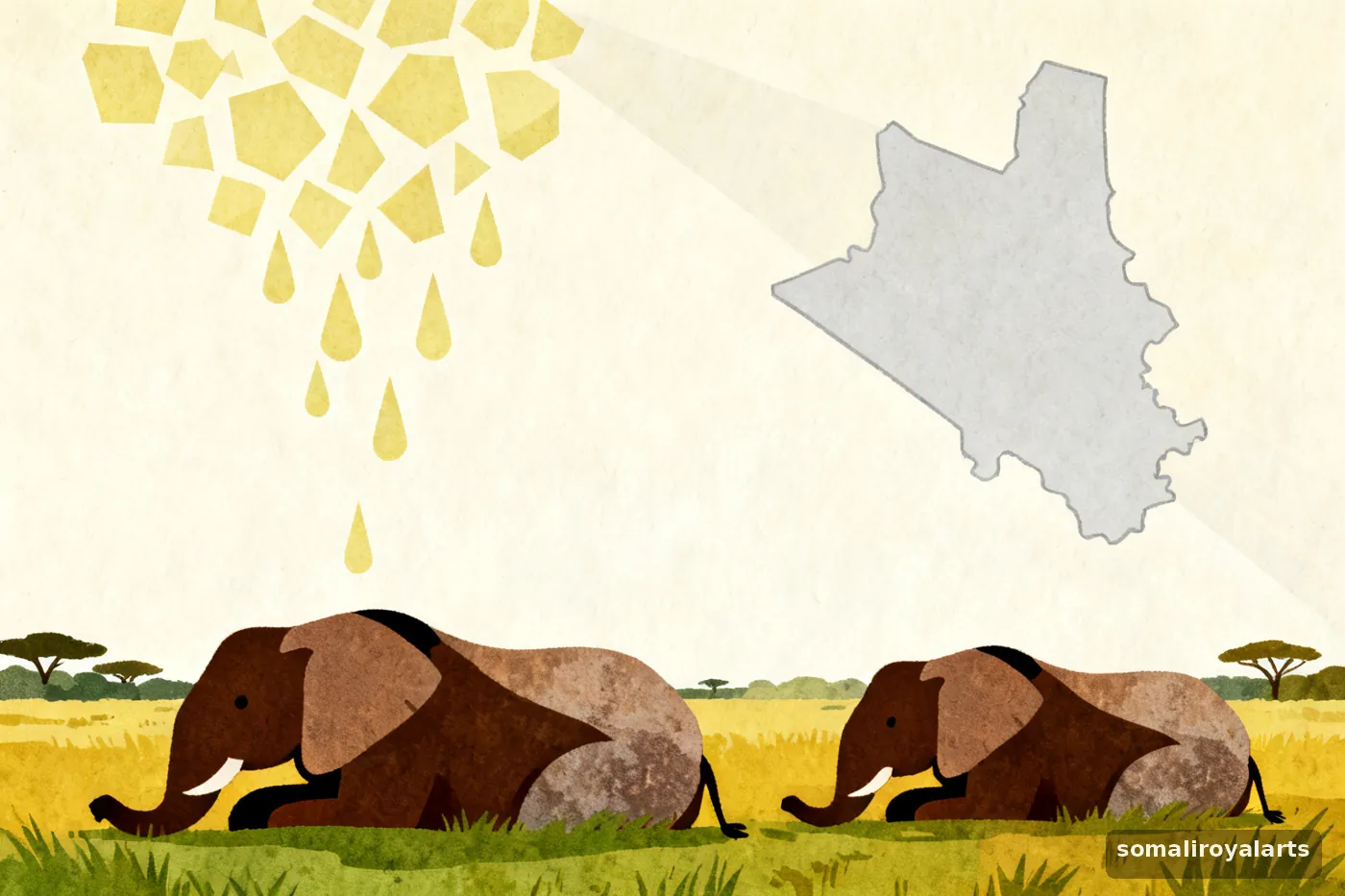
Kenya's mysterious elephant deaths raise questions over pesticides
Between 24 June and 24 July, some elephants that died in Kenya's Kimana area showed signs of partial paralysis, pointing to possible cyanide poisoning from pesticides. Fifteen elephants were affected in total. Kenya Wildlife Service's chief vet, Dr Isaac Lekolool, told the BBC that traces of cyanide had been found in samples from the elephants' stomachs and that deliberate poisoning had not been ruled out. "It's difficult to tell because we've not seen these kind of cases before. It is almost like a one-off, and it was within a period of about a month," he said. The working theory is that the elephants were exposed to pesticides sprayed on nearby tomato farms. "It could be unintentional. Maybe people are trying to do some controls of pests on their crops, and that could have been maybe a source," Lekolool said. But farmers and landowners have questioned that theory. Daniel Nina, who represents some local landowners, said: "We have stayed with this wildlife for decades and have never experienced this. So that's why we are wondering why it is happening today." Nina also pointed out that earlier farm poisonings had affected zebras and antelopes, and asked: "How does cyanide kill the elephants and leave behind the zebras, antelopes and wildebeests, which are eating the grass together?" Other experts who did not want to be named said the pesticide theory did not fit elephant behaviour. Males are more likely to raid farms, they said, yet only one of the 15 affected elephants was an adult male. A 2024 report by Kenyan food safety initiative Route to Food found a farmer in the Kimana area using an insecticide whose active ingredient is a cyanide compound. Wangunyu Njuguna, the report's author, said such agrochemicals are illegal in Kenya but some are smuggled across the border with Tanzania. "The biggest problem is we're not enforcing similar standards in the region," Njuguna said. "There is no-one checking what I go and buy across the border, so I can just go buy anything and walk through the border and no-one stops me." Several conservationists have also questioned KWS's initial findings. Paula Kahumbu, a world-renowned conservationist who has worked with elephants for nearly 30 years, said: "We haven't got enough detailed information to have confidence in this claim that it's due to pesticides in crops. Some information has been released to the public but it's not adding up. Those elephants have to eat a huge amount to kill them." The deaths have drawn attention to long-running human-elephant conflict around conservation areas. Stephen Michael, a tomato farmer in Kimana, said elephants and giraffes occasionally raid farms. "Elephants come from time to time from Tsavo and Amboseli. They destroy many farms, not just mine," he said. "The last time elephants came, they destroyed cabbages and tomatoes. I lost cabbages worth almost $1,535. That doesn't include tomatoes. I might start crying if I count that." Frank Pope, CEO of Save the Elephants, told the BBC that pressure on Amboseli's elephants is no longer mainly about ivory. Farms and lodges are taking up land around the park that elephants once used, worsening conflict with wildlife. "People are moving into areas where there's enough water to grow crops, and fertile soils, and those are the very areas that the elephants tend to use as well," Pope said. For now, nobody knows for sure what is causing the deaths. The fear is that the remaining elephants and the communities living near them are still at risk. The unfolding mystery in Kenya exposes weak border controls in East Africa, where banned agrochemicals can move easily. Somalia, a neighbour with its own smallholder farming sector and exposure to unregulated agrochemical imports, needs tighter monitoring and regional cooperation on pesticide safety before a similar case emerges closer to home.
Read our sourcing and corrections policy



Be the first to comment on this story!