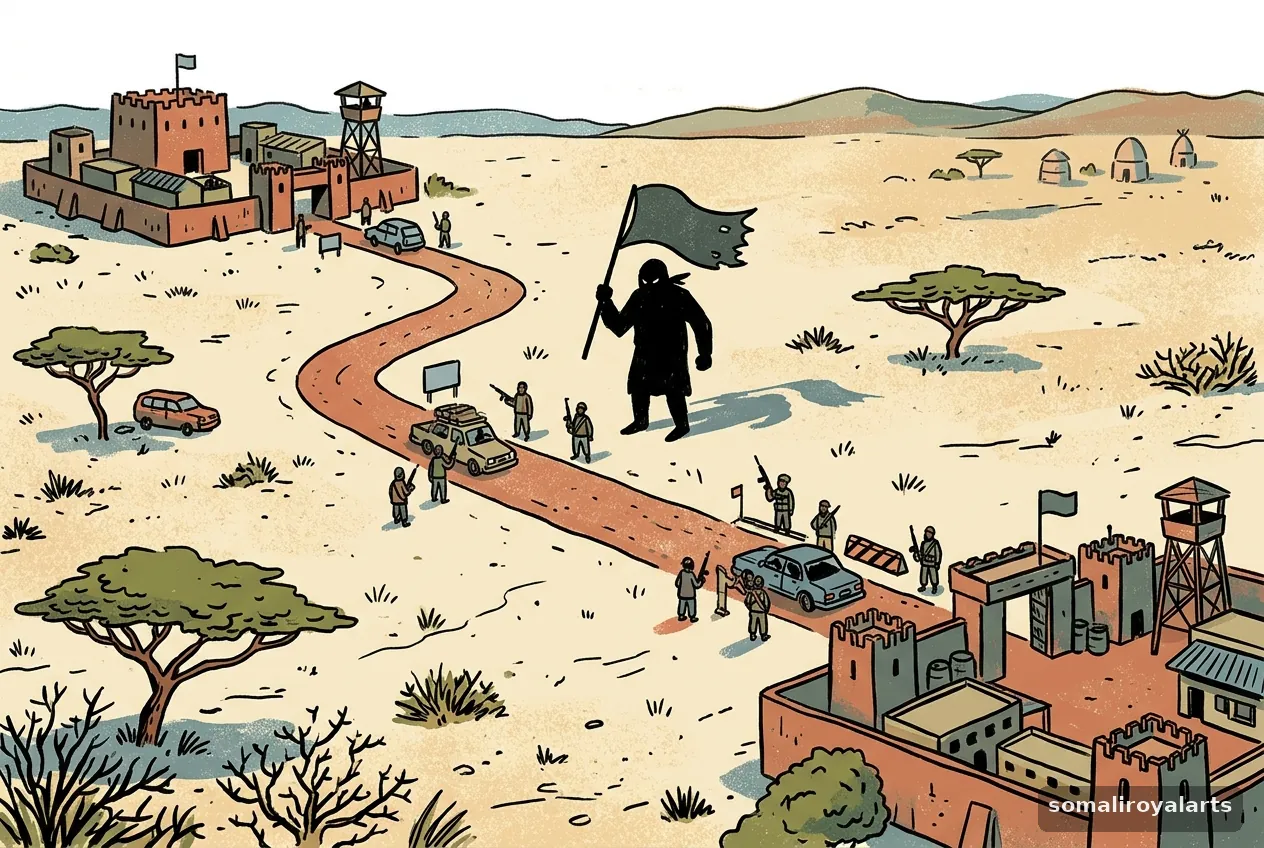
Somali Military Truck Destroyed on Awdhegle-Mubarak Road
A roadside bomb destroyed a truck carrying Somali soldiers between Awdhegle and Mubarak in Lower Shabelle on Monday. A military commander was among the losses, but the number of soldiers killed has not been independently verified. The attack demonstrated Al-Shabaab’s continued freedom of movement across the territory separating the two government-held garrisons. The Somali government recaptured Awdhegle in early October last year after months of operations focused on bridges over the Shabelle river. Security planners in Mogadishu regard five river crossings as approaches to the capital. With Barire and Sabid-Anole already held, Awdhegle became the third crossing covered by government forces. Ugandan infantry and Somali troops cleared Mubarak in March and then established a forward operating base in Qoryoley district. The two garrisons were intended to close a river corridor used by Al-Shabaab to move fighters and revenue toward Mogadishu. Instead, the campaign produced a chain of occupied points while the surrounding farmland, irrigation canals and feeder roads carrying sesame and sorghum to the capital’s markets remained under the control of the men who had taxed them for years. Even a short resupply journey consequently became an operation requiring its own planning. The device used on Monday was planted on the connecting road and struck a vehicle carrying many soldiers. Photographs circulated afterward showed the truck reduced to a frame beside the road, consistent with a charge designed to defeat an armoured cab. Accounts from the area put the death toll at more than a dozen. Al-Shabaab claimed more than 20 soldiers were killed, a figure it has reason to inflate and which no independent tally supports. A Somali journalist with extensive experience on the southern front reported 30 deaths and many injuries. The Somali government has issued no statement and published no casualty figure. The external support that helped secure these positions is also running against a deadline. Funding for the African Union mission expires on 31 December, and Washington has told the African Union that it will provide no logistics beyond that date. Turkish air power is expected to remain outside the mission, but the transition plan contains no replacement for a battalion capable of walking and clearing a route. Ethiopian troops withdrew from Buurhakaba this week after 12 years in the Bay region town and handed their positions to the Somali army. Three more towns are due to change hands during the same period. The United Nations office that supplies the mission with fuel, food and accommodation has also invited licensed auctioneers to bid to dispose of its inventory across Somalia, including vehicles, generators and prefabricated accommodation. Prime Minister Hamza Abdi Barre on Tuesday accused international partners of treating Somalia as though its transitional period had never ended. A week earlier, President Hassan Sheikh Mohamud sought the removal of a clause from a summit communiqué urging his government to engage the opposition, arguing that Somalia’s internal politics were a sovereign matter. The government’s silence leaves families in Mogadishu and the Shabelle valley seeking news of their sons through the propaganda outlets of the group that killed them. By abandoning the information space after such attacks, the state allows Al-Shabaab to publish the only available account, potentially costing the army recruits it cannot replace.
Read our sourcing and corrections policy



Be the first to comment on this story!