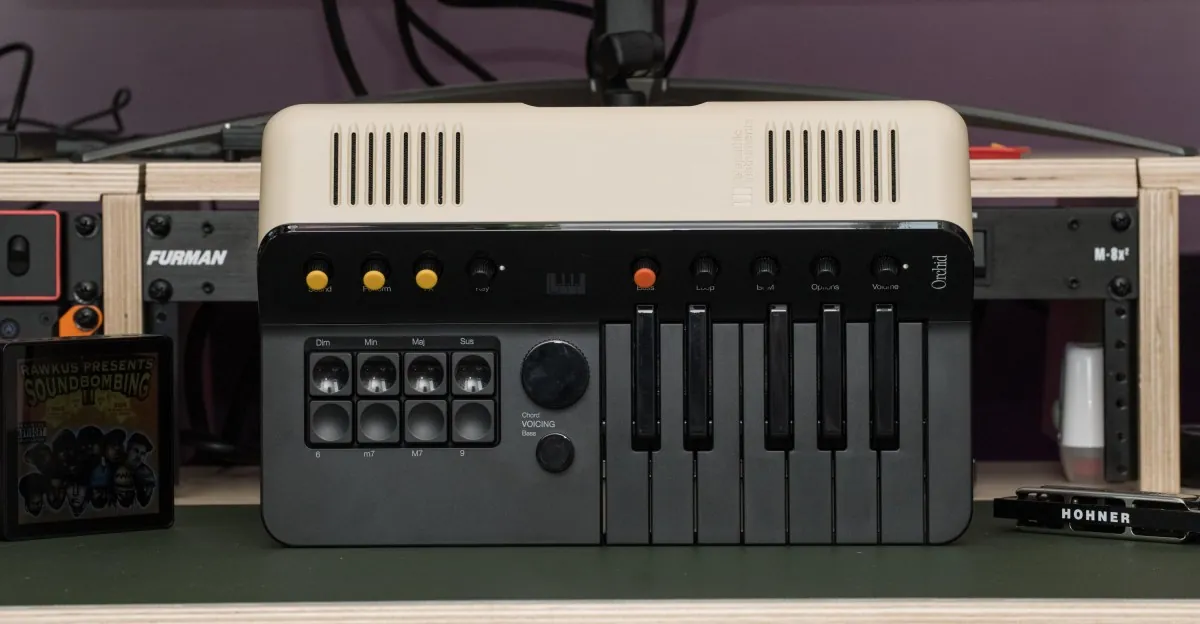
Telepathic Instruments' Orchid Revives Vintage Chord Organ Magic
Telepathic Instruments has introduced the Orchid, a new $649 digital instrument designed in collaboration with Tame Impala frontman Kevin Parker. The device aims to revive the accessible, push-button playability of vintage chord organs from the 1960s and 1970s. Aesthetically, it draws heavy inspiration from classic parlor instruments produced by companies like Magnus and Bontempi, featuring a brown-and-tan color scheme and a speaker grill that mimics traditional fan vents. Rather than focusing on deep synthesizer programming, the Orchid is positioned primarily as an accessible tool for songwriters looking to sketch out harmonic ideas without requiring extensive music theory knowledge or complex fingerings. The original electric chord organs allowed musicians to play full chords simply by pressing a single button, making them an ideal choice for amateur players and aspiring songwriters working at home. These instruments largely fell out of fashion in the 1980s as digital keyboards, particularly those manufactured by Casio, began to dominate the entry-level market. While a vintage Magnus chord organ might occasionally surface on Craigslist for as little as $10, these older machines are strictly limited in their harmonic range by the physical number of reeds they contain. The Orchid attempts to capture that same immediate playability while replacing the physical reeds with a fully digital architecture capable of playing any chord voicing from any scale. Navigating the instrument is designed to be highly intuitive, even for those with minimal formal training. The hardware features a simple one-octave keyboard on the right side, flanked by a cluster of buttons on the left that dictate chord types, including major, minor, diminished, and major 7th. Pressing the C key alongside the major button instantly produces a C major chord, while pressing F# and a 9 button yields an F#9. To further prevent musical missteps, users can lock the Orchid to a specific musical key, such as E minor or Bb major, ensuring that every button press produces a chord that fits perfectly within the chosen scale. Unlike vintage organs, which were largely defined by a droney, accordion-like timbre that artists like El-P still occasionally use, the Orchid features a significantly broader sonic palette. Under the hood, it runs three distinct synthesizer engines: a virtual analog (VA) engine for traditional synth tones, an FM engine suited for 1980s-style electronic pianos and bells, and a reed piano engine modeled after classic Wurlitzer and Rhodes electric pianos. The instrument ships with 70 built-in presets covering most essential keyboard tones. Additionally, the Orchid can function as a standard MIDI controller, allowing producers to trigger sounds from external software or other hardware synthesizers using its one-key chord system. Beyond simply holding static chords, the Orchid includes various performance modes that add movement to the music. Users can select from arpeggiator, strum, and harp modes, alongside 13 distinct preprogrammed rhythmic patterns. One standout feature is the "slop" mode, which deliberately introduces random timing imperfections into the chord strikes. As the user increases the slop intensity, the notes are triggered more unevenly, closely approximating the natural inconsistencies of a human musician rather than the rigid quantization of a machine. For fuller arrangements, the instrument houses a dedicated bass synthesizer and a built-in drum machine. The bass section offers 12 specific sounds, ranging from low electric piano octaves to Moog-style analog bass, tuned 808 hits, and heavy EDM drones, all of which can be layered under the main keys or played solo. The drum machine takes its cues from 1970s rhythm boxes like the Korg Mini Pops, delivering a lo-fi sound designed to accompany home organ playing. Because the Orchid is strictly monophonic on its keyboard—meaning users cannot play a melody and a separate bassline simultaneously on the keys without notes cutting off—it includes an audio looper to let players record and stack their chord progressions, basslines, and melodies independently. Despite its immediacy, the Orchid has notable limitations, particularly regarding sound design and hardware flexibility. While it costs $649, users cannot alter the presets deeply beyond adjusting the filter cutoff or tweaking the intensity of built-in effects like reverb and phaser. Creating custom patches requires purchasing a separate virtual synthesizer called Pistil, which costs an additional $99 (or $50 if bundled with the hardware). Early users have noted that the Pistil software can be buggy, with the user interface occasionally freezing when transferring patches to the Orchid. Furthermore, the one-octave keyboard cannot be used to play traditional chords; all chords must be triggered via the left-side buttons, which differs from vintage units that allowed standard two-handed playing on their full keyboards. The Orchid is not intended to compete with comparably priced, feature-rich synthesizers like the Korg Minilogue or the Arturia MiniFreak. It is fundamentally a compositional notebook rather than a sound designer's playground. For a singer-songwriter struggling to play complex arrangements while focusing on lyrics and vocal melodies, the push-button system reduces a significant mental burden. It provides a specialized, electronic alternative to the standard acoustic guitar or upright piano for drafting new music. For Somali music producers and studio owners in the Horn of Africa and the diaspora, the Orchid's $649 price tag presents a steep barrier for a single-purpose songwriting tool, particularly when standard MIDI controllers offering similar one-finger chord functions through software cost a fraction of the price. The additional $50 requirement for the Pistil software just to create custom sound design means the total investment remains impractical for regional studios that typically rely on versatile, multi-purpose equipment rather than specialized, limited hardware.
Read our sourcing and corrections policy
This article was prepared by our automated editorial system, which summarized and translated the source above. No human editor reviewed this article individually before publication.



Be the first to comment on this story!